
Turning one-time gifts into lasting support
Overview
Redesigning how a nonprofit says thank you
Wounded Warriors Canada is a national mental health service provider supporting veterans, first responders, and their families through programs like the PTSD Service Dog Program, the Trauma Resiliency Program, and Warrior Kids Camp. Like most nonprofits, they depend on long-term donor relationships to keep those programs running.
Our team of seven partnered with Wounded Warriors Canada to research and redesign their donation experience end-to-end from the moment someone considers giving, through the donation flow itself, to what happens after the gift is made.
The Impact
We delivered a donor onboarding system built around a physical welcome package, a milestone recognition program, a story-driven multi-platform ad campaign, and a set of website redesign recommendations — all grounded in 32 interviews, a live usability test of the real donation flow, and a comparative study of a peer organization.
Problem
Donors give once, but rarely come back
Wounded Warriors Canada earns trust through its mission, but has no structured way of recognizing the people who support it. First-time donors are treated almost identically to lifelong supporters, and the digital donation flow assumes a level of familiarity that new, younger donors simply don't have.
This left us with our guiding research question:
Research
32 interviews, a real donation, and a competitor deep-dive
50 / 35 / 15
split between emotion-driven, logic-driven, and hybrid donors
We combined interviews, a comparative analysis, and hands-on usability testing to understand both why younger donors hesitate to give and where the existing donation flow breaks down.
What we learned
Financial anxiety, not apathy, was the biggest barrier to giving for people aged 20–30 — most cited student debt, rent, and an unstable job market. Trust in nonprofits was generally high, but conditional on transparency: users wanted proof their money went where they were told it would.
To gain first-hand insight into the actual donation flow, we made a real $25 donation and documented every step. The process assumed familiarity with the organization, offered no explanation of what donation categories meant, and ended with a generic, unpersonalized thank-you email that didn't reflect the program the donor had chosen.
We also studied the Lions Foundation of Canada Dog Guides, a nonprofit with a similar service dog program. Their retention strategy leans on handwritten notes, phone calls from board members, and a named donor circle small, personal gestures that Wounded Warriors Canada currently has no equivalent of.
Ideation
From one-off gifts to an ongoing relationship
Each team member brought one idea to the table, and we stress-tested them against our research before converging on four directions that reinforce each other rather than compete.
Milestone recognition program
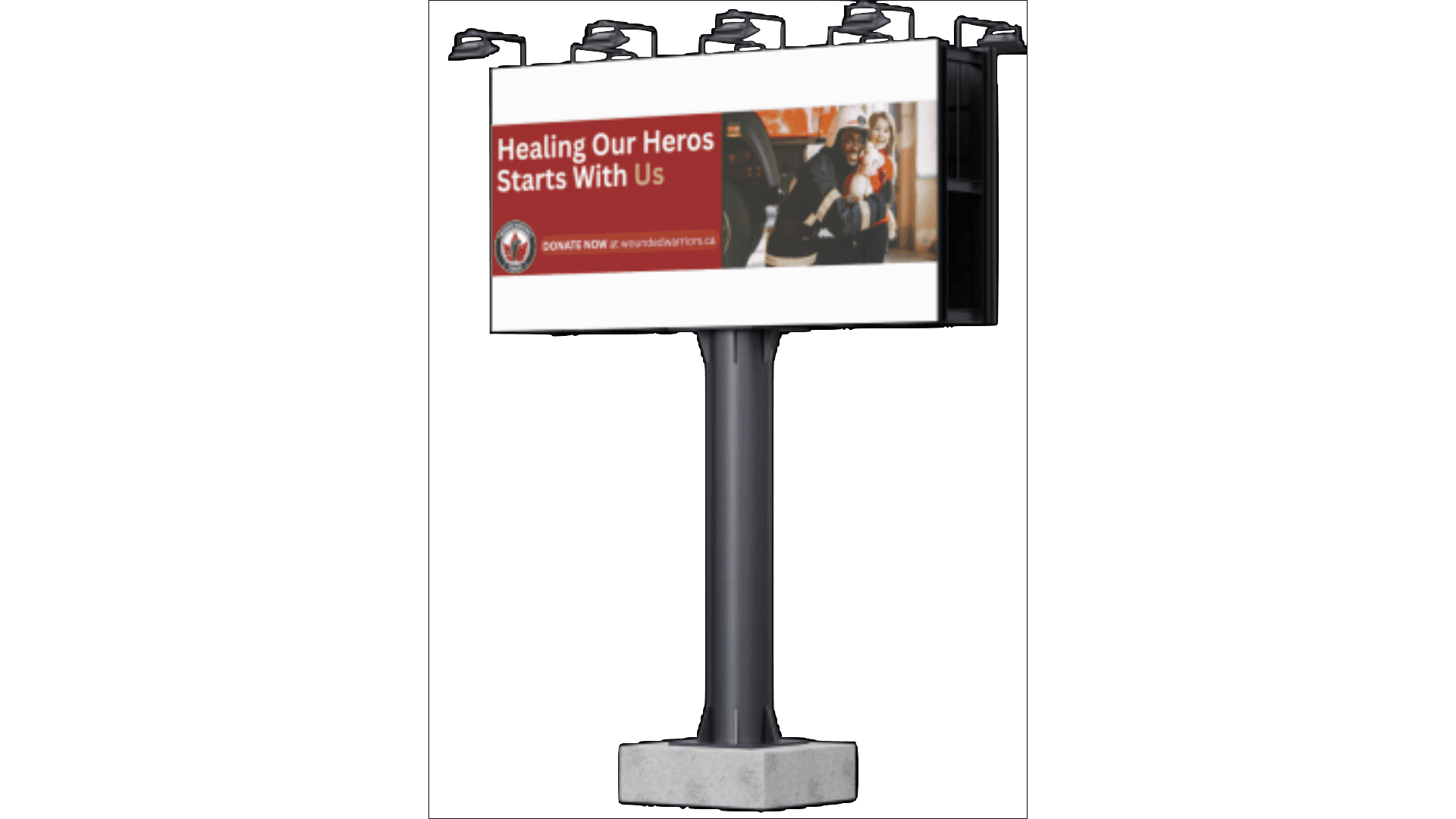
Story-driven ad campaign
Why these four
A structured onboarding experience, starting with a personalized welcome package, turns a single transaction into the start of a relationship. A milestone-based recognition program (a 6-month anniversary, a holiday, a large gift) keeps that relationship alive without turning generosity into a transaction. A multi-platform campaign built on real, relatable stories was designed to reach the 50% of donors who give when they feel personally connected to a cause. And a redesigned donation flow removes the friction we saw firsthand during usability testing.
Designs
From ad campaign to the box on someone's doorstep
The final deliverables spanned three layers: an awareness campaign to bring new and younger donors in, a set of program postcards used across the welcome package and mailers, and the physical welcome package itself.
Posters



PTSD Service Dog Program
Postcard pair for the PTSD Service Dog Program, pairing an emotional story with concrete stats for the 35% of donors who need both.
Postcards
The welcome package


Outcome
Retention is a design problem, not just a fundraising one
The final deliverable combined a validated business model with a working, testable prototype, and the pitch earned 2nd place in our class competition. Beyond the placement, this project taught me how to translate a business idea into something tangible and usable
Younger donors don't lack generosity; they lack proof transparency has to be designed in, not bolted on afterward.
A single unexplained step in a donation flow (like unlabeled program categories) is enough to send an unfamiliar donor away
Small, personal gestures a handwritten note, a program-specific follow-up do more for retention than broad campaigns.
Usability testing on real, live products (like actually donating $25) surfaces friction that a static prototype review never would
